
You’ve invested in a website, published content, and started working on SEO. But there’s one question every business owner eventually asks:
How long does SEO take to show results?
Will your website start ranking on Google in a few weeks? Will organic traffic increase within a month? Or does building a strong presence in search engines take much longer?
The honest answer is that SEO takes time. Unlike paid advertising, where visibility can begin as soon as a campaign goes live, SEO is a long-term process that builds your website’s visibility, authority, and organic traffic over time.
For many websites, meaningful improvements can begin to appear within 3 to 6 months, while stronger and more consistent results may take 6 to 12 months or longer. However, your actual SEO results timeframe depends on your website’s condition, competition, industry, content quality, and the effectiveness of your strategy.
In this guide, we’ll break down a realistic SEO timeline, explain what happens at each stage, and explore the factors that influence how quickly your business can see results.
What Is SEO and Why Does It Take Time?
Search Engine Optimization (SEO) is the process of improving your website so that it can appear more prominently in relevant search engine results.
It involves several activities, including:
- Keyword research and search intent analysis
- On-page SEO optimization
- Technical SEO improvements
- Content creation and optimization
- Website structure and internal linking
- Link building and authority development
- Performance monitoring and ongoing improvements
SEO takes time because search engines need to discover, crawl, understand, and evaluate your website’s pages. Your content also needs to compete with other websites targeting similar keywords.
Publishing a new page doesn’t automatically place it at the top of Google. Your website needs to demonstrate relevance, usefulness, and credibility in a competitive search environment.
The goal isn’t just to get indexed. It’s to build a website that deserves to be found.
How Long Does SEO Take to Show Results?
There isn’t one guaranteed timeline for every website. However, the following breakdown provides a realistic starting point for understanding how SEO progress often develops.
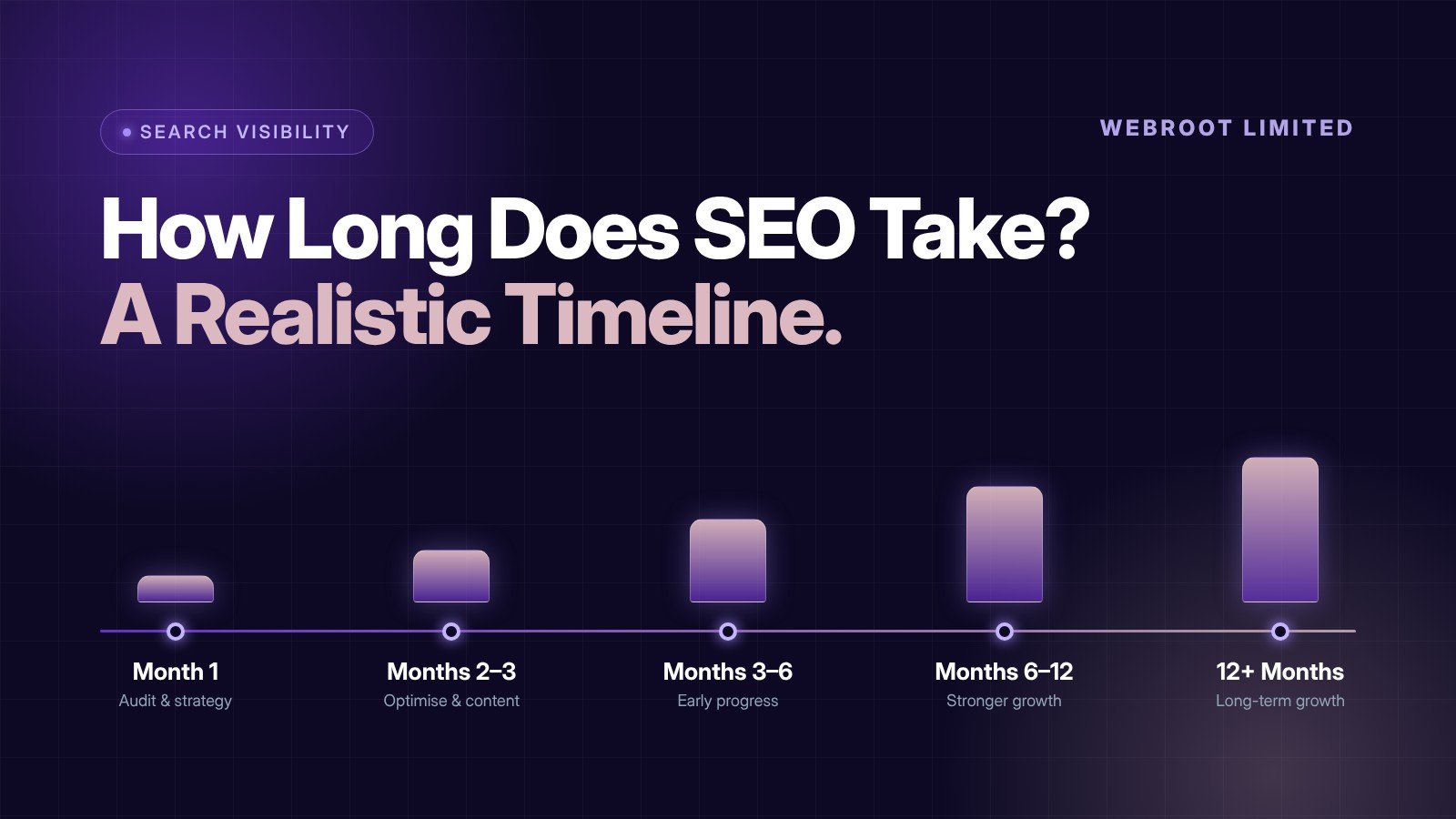
A realistic SEO timeline
- Month 1: SEO Audit and Strategy — Research, technical checks, keyword mapping, competitor analysis, and identifying website issues.
- Months 2–3: Optimization and Content — Improving website pages, publishing useful content, fixing technical problems, and strengthening internal links.
- Months 3–6: Early SEO Progress — Some pages may gain visibility, keyword rankings may improve, and organic traffic may begin to grow.
- Months 6–12: Stronger Growth — More consistent rankings, increased organic traffic, improved authority, and potential growth in enquiries and conversions.
- 12 Months and Beyond: Long-Term Development — Continued content development, optimization, authority building, and efforts to maintain and improve search visibility.
These are illustrative stages, not guaranteed milestones. Some websites progress faster, while competitive or technically weak websites may take longer.
Let’s look at what happens during each stage.
Month 1: Website Audit, Keyword Research, and SEO Planning
The first month is usually about understanding your website and building the right strategy.
Before expecting ranking improvements, SEO specialists need to identify what’s working, what’s holding the website back, and where opportunities exist.
Key activities include:
- Conducting a complete SEO audit
- Researching relevant keywords
- Reviewing competitors
- Checking website indexing and crawlability
- Identifying technical SEO issues
- Reviewing existing content
- Planning page-level optimization
For example, a local web development company may want to rank for a broad keyword such as “web development services.”
However, more specific searches such as “web development company in London” may better match its target audience and business goals.
Choosing the right keywords from the beginning helps create a more focused SEO strategy.
What to expect: A clear SEO roadmap, identified website issues, and a prioritized list of improvements. Significant ranking growth isn’t necessarily expected at this stage.
Months 2–3: On-Page SEO and Content Optimization
Once the initial research is complete, the next step is implementing improvements.
This stage focuses on making your website more relevant, useful, and accessible to both search engines and visitors.
Typical activities include:
- Optimizing title tags and meta descriptions
- Improving page headings and content structure
- Adding relevant keywords naturally
- Creating service pages and informative blogs
- Improving internal linking
- Optimizing images and alternative text
- Improving mobile usability and page performance
Content also plays an important role.
Suppose you offer digital marketing services. Instead of relying on one general services page, you could create dedicated pages for SEO, social media marketing, paid advertising, and content marketing.
This gives each page a clearer purpose and helps it target more specific search intent.
What to expect: Better page structure, improved content relevance, and early signs of search visibility as search engines discover and process your updates.
Months 3–6: Early Rankings and Organic Traffic Growth
This is often the stage when businesses begin looking for measurable SEO improvements.
Some optimized pages may start appearing for relevant search queries. Certain keywords may move up in search results, and organic impressions and clicks may increase.
However, not every keyword will improve at the same speed.
Less competitive and more specific keywords may show progress earlier than highly competitive search terms.
For example:
- “SEO services for small restaurants” may be more achievable than “SEO services.”
- “Affordable Shopify website development” may be more targeted than “website development.”
At this stage, SEO teams should monitor:
- Keyword ranking movements
- Google Search Console impressions
- Organic clicks
- Organic landing-page performance
- Pages gaining search visibility
- Technical issues and indexing status
What to expect: Early ranking improvements and potential organic traffic growth. Results will vary depending on competition, website history, and the quality of implementation.
Months 6–12: Building Stronger Search Visibility
By this stage, a consistent SEO strategy may begin delivering more noticeable results.
Your website may rank for a wider range of relevant keywords, attract more organic visitors, and generate more opportunities through search.
However, reaching this stage doesn’t mean SEO work is finished.
Search competitors continue publishing content, updating their websites, and improving their search strategies. Your business needs to keep developing its online presence.
Focus areas include:
- Updating existing content
- Publishing new, valuable articles
- Improving pages with high impressions but low clicks
- Strengthening relevant internal links
- Building quality backlinks naturally
- Improving user experience
- Tracking enquiries and conversions
What to expect: Potentially stronger organic visibility, more consistent traffic, and improved opportunities to convert search visitors into customers.
7 Factors That Affect How Long SEO Takes
Why does one website see improvements in three months while another takes a year or longer?
Because SEO performance depends on several factors.
1. Your Website’s Age and History
An established website with useful content, relevant backlinks, and a history of organic traffic may have a different starting point from a newly launched website.
New websites often need time to build visibility and establish credibility.
However, an older domain doesn’t automatically rank better. The quality and relevance of the website still matter.
2. Keyword Competition
Your target keywords have a major influence on your SEO timeline.
Ranking for a specific local search may be more achievable than competing for a broad keyword targeted by major brands and established websites.
For example:
| Keyword | General competition consideration |
|---|---|
| Web design company in Manchester | More specific local intent |
| Web design services | Broader search intent |
| Digital marketing agency | Highly competitive in many markets |
These are examples, not measured competition scores. Actual difficulty depends on the search market and competing pages.
3. Content Quality and Search Intent
Publishing blogs regularly doesn’t guarantee higher rankings.
Your content needs to answer the questions people are actually searching for.
A useful article should provide clear information, practical advice, relevant examples, and a better experience than a generic piece of content.
If your content doesn’t satisfy search intent, adding more keywords won’t solve the problem.
4. Technical SEO
Technical issues can prevent search engines from properly accessing or understanding your website.
Common problems include:
- Broken links
- Incorrect indexing settings
- Duplicate content
- Slow-loading pages
- Poor mobile usability
- Incorrect redirects
- Website crawlability issues
Fixing these problems can help search engines access your important pages more effectively.
5. Backlinks and Website Authority
Relevant, trustworthy backlinks can help search engines understand how your website is connected to the wider web.
However, backlink quality matters more than simply collecting a large number of links.
Avoid spammy link-building schemes and focus on earning relevant links through useful content, partnerships, industry resources, and genuine brand mentions.
6. Consistency of SEO Efforts
SEO is not a one-time activity.
Optimizing your website once and leaving it untouched for months is unlikely to support sustainable growth.
Consistent content improvements, technical maintenance, performance analysis, and strategic optimization help your website adapt to changing search competition.
7. Your Industry and Location
SEO timelines can differ significantly across industries and locations.
A small local business targeting a specific service area may face different competition from an international e-commerce brand targeting thousands of product-related keywords.
Your SEO strategy should reflect the market you’re trying to reach.
How Do You Know If Your SEO Is Working?
One common mistake businesses make is judging SEO only by keyword rankings.
Rankings matter, but they don’t tell the whole story.
A website can improve its search visibility before generating a noticeable increase in enquiries or sales. That’s why you should monitor several performance indicators.
Here are six important SEO metrics to track:
| SEO Metric | What It Tells You |
|---|---|
| Keyword rankings | Where your pages appear for target searches |
| Organic impressions | How often your pages appear in search results |
| Organic clicks | How many people visit from unpaid search results |
| Click-through rate (CTR) | How often search impressions turn into clicks |
| Organic conversions | How many visitors complete valuable actions |
| Backlink profile | The quality and relevance of links pointing to your website |
Useful tools for tracking SEO progress:
- Google Search Console: Monitor search impressions, clicks, indexing, and queries
- Google Analytics 4: Understand organic visitor behaviour and conversions
- Google PageSpeed Insights: Evaluate page performance and identify opportunities for improvement
- SEO platforms: Research keywords, analyze competitors, and monitor ranking changes
The most important thing is to connect SEO performance with business outcomes. More traffic is valuable, but attracting visitors who are likely to become customers is even better.
Why SEO Is a Long-Term Investment, Not an Overnight Solution
Many businesses expect SEO to produce immediate results because they compare it with paid advertising.
However, the two work differently.
| SEO | Paid Advertising |
|---|---|
| Builds organic search visibility | Provides paid visibility |
| Requires ongoing optimization | Requires campaign management |
| Results generally develop over time | Traffic can start shortly after launch |
| Can generate traffic without paying for each click | Typically involves paying for clicks or impressions |
| Builds long-term search presence | Visibility depends on active campaign budgets |
This doesn’t mean SEO is better than paid advertising in every situation.
In fact, combining SEO with paid advertising can be an effective approach. Paid campaigns can help generate immediate traffic while SEO builds your website’s long-term organic presence.
The smartest strategy is to understand what your business needs now and what will support its growth in the future.
5 SEO Mistakes That Can Delay Your Results
Even with a good SEO budget, certain mistakes can slow down progress.
1. Expecting First-Page Rankings Too Quickly
SEO requires research, implementation, testing, and continuous improvement. Promising guaranteed first-page rankings within a few weeks is unrealistic.
2. Targeting the Wrong Keywords
Choosing keywords only because they have high search volume can attract irrelevant visitors.
Focus on keywords that match your services, audience, and business objectives.
3. Publishing Content Without a Strategy
Random blog publishing won’t necessarily improve your search visibility.
Every article should have a purpose, target search intent, and connect naturally with relevant pages on your website.
4. Ignoring Technical SEO
Even excellent content can struggle if important pages aren’t accessible, properly indexed, or technically sound.
5. Stopping SEO Too Early
SEO requires consistency. Stopping optimization after a few months can interrupt progress, especially when competitors continue improving their websites.
Can You Speed Up SEO Results?
You cannot force search engines to rank your website overnight, but you can avoid unnecessary delays by following a structured strategy.
Here are some practical ways to make your SEO efforts more effective:
- Fix critical technical SEO issues early.
- Target relevant keywords based on search intent.
- Optimize important service and landing pages.
- Publish genuinely useful, original content.
- Improve internal linking between related pages.
- Make your website mobile-friendly and easy to navigate.
- Earn relevant, quality backlinks.
- Monitor performance and update underperforming pages.
One important point: don’t focus on publishing as much content as possible. Focus on publishing content that genuinely helps your audience.
A smaller number of well-researched, strategically optimized pages can be more valuable than dozens of low-quality articles.
Frequently Asked Questions About SEO Timelines
1. How long does SEO take for a new website?
A new website may take several months to establish search visibility. Some pages may start gaining impressions and rankings within 3–6 months, while competitive keywords can take considerably longer.
2. Can SEO show results in one month?
Yes, some early improvements may appear within a month, particularly after fixing technical issues or optimizing existing pages. However, significant and consistent organic growth within 30 days is not something businesses should expect.
3. How long does it take to rank on Google’s first page?
There is no fixed timeframe. It depends on keyword competition, content quality, website authority, technical health, and the strength of competing pages. Some specific keywords may be achievable sooner, while highly competitive terms can take much longer.
4. Does SEO need to be done every month?
SEO benefits from ongoing attention. Search trends, competitors, website content, and technical requirements change over time. Regular monitoring and optimization help maintain and improve performance.
5. Is SEO better than Google Ads?
They serve different purposes. Google Ads can provide paid visibility quickly, while SEO focuses on building organic search visibility over time. The right choice depends on your budget, goals, competition, and desired results.
6. How can I check whether my SEO is improving?
Google Search Console and Google Analytics 4 are useful starting points. Track organic clicks, impressions, keyword performance, landing-page traffic, and conversions rather than relying on rankings alone.
Final Thoughts: SEO Takes Time, but the Right Strategy Makes It Worthwhile
So, how long does SEO take?
For many businesses, early improvements may become visible within 3–6 months, while stronger and more consistent results can take 6–12 months or longer.
But remember, SEO isn’t simply about waiting for Google to rank your website. It’s about continuously improving your online presence, creating valuable content, fixing technical issues, and making it easier for potential customers to find your business.
The businesses that approach SEO with realistic expectations and a consistent strategy are better positioned to build sustainable organic visibility.
Don’t chase overnight rankings. Build a website that deserves long-term visibility.
Want to Improve Your Website’s Google Rankings?
At WebRoot Limited, we help businesses strengthen their online presence through strategic SEO services, including:
- Keyword Research
- On-Page SEO
- Technical SEO
- Content Optimization
- Website Performance Optimization
- Off-Page SEO
Whether you’re launching a new website or trying to improve an existing one, we can help you build an SEO strategy around your business goals.
Ready to grow your organic visibility?
Contact WebRoot Limited today and let’s make your business easier to find on Google.